Free Slot Machines: Classic Reels Online
9 min
The machine that refused to die
Almost every casino game has been redesigned, rebranded or replaced at some point. The slot machine simply absorbed each new technology and carried on doing the same thing it has always done: show you three or five columns of symbols, spin them, and let you find out. Mechanical levers became buttons, physical reels became pixels, and the fruit and the sevens survived all of it because the loop underneath was already perfect.
That loop is the reason free slot machines work so well as pure entertainment. Take the money away and the core action is still intact — anticipation, resolution, a small burst of feedback, repeat. It is one of the tightest feedback cycles ever built into a piece of consumer software, and it predates the software by the better part of a century.
It is also the most democratic game ever put on a casino floor. Nothing about a slot machine requires knowledge, nerve, etiquette or an understanding of odds, and nobody at the table can make you feel foolish because there is no table. That accessibility is exactly why slots came to dominate casino revenue, and why the free versions have such a broad audience — the barrier to entry has always been essentially zero, and now the cost is too.
What made the physical machine tick
The original machines were honest in a very literal way: the odds were the reels. Symbols were printed on physical strips, and the number of each symbol on each strip was the entire mathematics of the game. If you could see the strips, you could calculate the game. That constraint is what kept early machines simple — you cannot fit a complicated maths model onto three metal hoops.
The move to computer control broke that ceiling. Once a virtual reel strip could be as long as the designer wanted, the visible symbols stopped being the odds and became a display of the odds. This is the single most consequential change in the history of the machine, and it is why a modern slot can show you three reels while running mathematics of nearly unlimited complexity behind them.
The consequence is that the phrase reading the reels is now meaningless. On a mechanical machine, a careful observer could in principle count the symbols and derive the odds. On a modern machine, the symbols you can see have no fixed relationship to their true frequency, because the same visible symbol may occupy one position on one virtual strip and thirty on another. Anyone still claiming to read a machine is describing a skill that stopped existing decades ago.
The grammar of cherries, bars and sevens
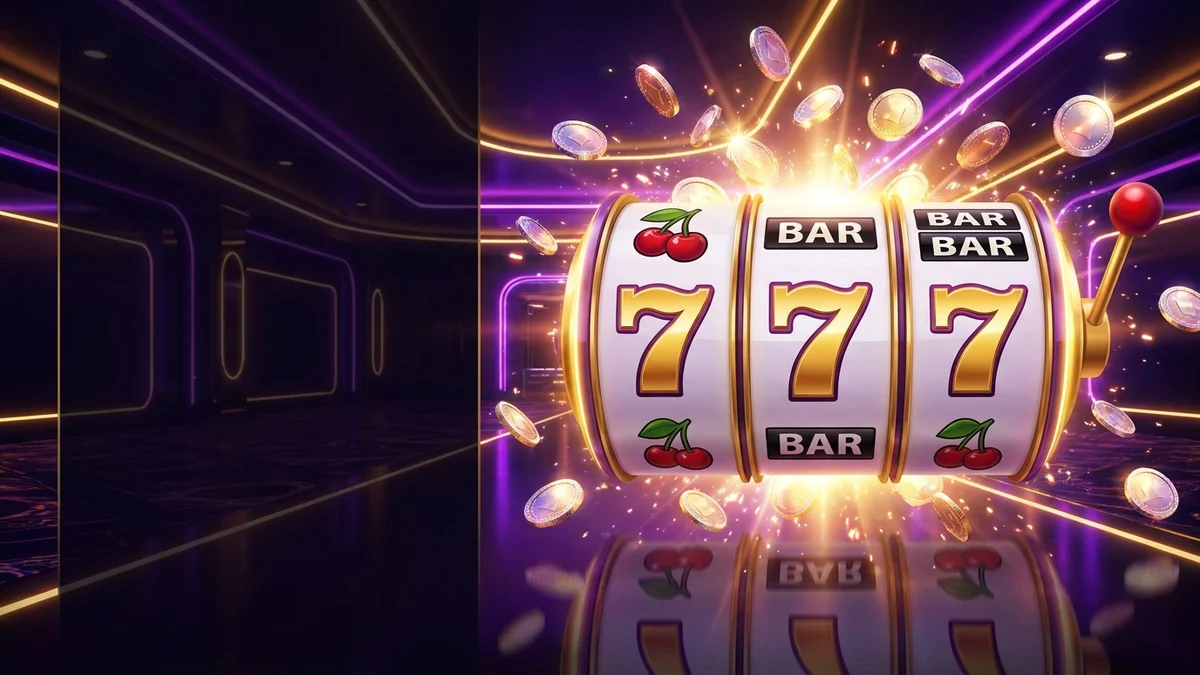
Classic symbol sets are not arbitrary decoration, they are a functioning visual language. Fruit is the low tier, bars form a legible ladder — one bar, two bars, three bars — and the seven sits at the top as the payoff symbol. Anyone who has ever glanced at a slot understands this hierarchy without ever having been taught it, which is a remarkable piece of accidental design.
That legibility is the whole appeal of a classic reel set. Nothing needs explaining. You do not open an info screen, you do not learn a proprietary feature name, you do not track a multiplier grid. Three symbols, one line, immediate resolution. In an era of games with four nested mechanics, that austerity has started to feel less like nostalgia and more like relief.
Three reels, and the tyranny of the middle line
The classic format concentrates everything onto very few outcomes, which produces a peculiar tension. On a modern grid game your eye takes in the whole board at once. On a three-reel machine you watch one reel at a time, and the first two landing on sevens creates a moment of pure, undiluted suspense that no amount of cascading animation has ever quite replicated.
It is also the format most obviously exposed to the near-miss. When only one line matters, missing it by one position feels like a personal insult, and the machine happily lets you feel that. Free play is the ideal place to sit with this sensation and notice how effectively it works on you — because it works just as hard on virtual credits as it does on real ones.
That concentration is also why classic machines feel so much faster. There is nothing to evaluate. A modern grid game asks you to scan a whole board, tally clusters, track a multiplier and wait for tumbles to resolve, and each spin takes several seconds of processing before you even know how you did. Three reels resolve instantly and honestly, and for a certain kind of player that immediacy is worth more than any feature.
How video reels changed the emotional shape
Five-reel video machines did not just add reels, they added time. A base game could now be a long, patient corridor leading to a feature, and the feature could be a set piece with its own rules, music and escalation. That structural change is why a game like The Dog House can hold back its sticky wilds for hundreds of spins and still feel like it is going somewhere.
It also allowed the payout curve to be dragged out of the base game and stuffed into the bonus. The result is the modern experience: long stretches of not very much, punctuated by short bursts where all the game’s value is delivered at once. Whether that is an improvement is genuinely a matter of taste, and free play lets you settle the argument for yourself by playing both eras back to back.
Sound is half the machine
Slot audio is not background music, it is instrumentation. The rising tone as a scatter lands, the extra beat of silence before a reel stops, the change in pitch when a win is being counted up — every one of those is a designed cue, and they are extraordinarily effective at manufacturing anticipation out of what is mathematically a non-event.
Play a machine with the sound off for ten minutes and then turn it on. The maths has not changed by a single decimal. The experience will feel like a different game. That gap is the clearest possible demonstration that a slot is a presentation layer wrapped around a random draw, and understanding it is oddly liberating.
The counting-up sound deserves special mention, because it is one of the great pieces of manipulative design in any medium. Stretching a payout over several seconds of ascending tones turns a number into an event, and the length of the animation is only loosely related to the size of the win. A game can make a trivial result feel like an occasion simply by taking its time about telling you, and almost every slot does exactly that.
The near-miss, and why it is not an accident
Two jackpot symbols landing with the third stopping just above the line is one of the most reliably arousing things a slot can show you, and reel strips are frequently built so that it happens far more often than pure chance would suggest. This is not a conspiracy — it is a well-documented feature of how virtual reels are weighted, and it has been part of the craft for decades.
Knowing this does not stop it working, which is the uncomfortable part. It does, however, change what you do about it. A near-miss is not evidence that the game is close to paying, because the game is never close to anything. It is a picture designed to make you press the button again, and recognising it as a picture is the beginning of playing with your eyes open.
Classic versus modern in the free library
The catalogue here leans modern, but the older sensibility is well represented. Wolf Gold and Wild West Gold are conventional reel games with clean paytables and features you can describe in a sentence. Big Bass Bonanza runs a straightforward five-reel base game and a bonus round with a single, legible idea. Set those against the tumbling grids of Sweet Bonanza or Sugar Rush and the difference in philosophy is immediate.
Nobody is right in that argument. Some players want a chain of cascading multipliers and a screen that never stops moving. Others want three columns, a clear line and a result. The reason to play both for free is that you almost certainly do not know which you are until you have spent an hour with each.
If you want a compact tour of that philosophical split, spin Big Bass Bonanza and then spin Sugar Rush. Both are excellent. One asks you to hold a single question in mind and answers it cleanly. The other asks you to track a board that is quietly rewriting its own value as you play. They are barely the same medium, and the fact that both are called slots says something about how far the form has stretched.
What a free machine can still give you
Everything except money, essentially. The anticipation is real, the near-miss lands exactly as hard, the bonus round detonates with all its intended fanfare, and the reels stop with the same little jolt. What you lose is the sick feeling when the balance falls faster than expected, and it is worth asking honestly whether that feeling was ever a part of the entertainment or just the price of admission.
Free slot machines answer that question empirically. Spin for an hour with nothing at stake and see whether you enjoyed yourself. If the answer is yes, you have found a genuinely cheap hobby. If the answer is no, you have learned something considerably more valuable than any win could have taught you.
Spinning them here
Every machine in this library opens in the browser on virtual credits — no installer, no account, no deposit, no cashier. Reload the page when the credits run out and carry on. The games are served in fun-play mode by their studios, and a small number may be unavailable in certain regions because of restrictions applied at the provider’s end.
Nothing here can be won and nothing can be withdrawn, and that is the point rather than a limitation. Enjoy the reels for the century-old machine they descend from. If you take these games to a real-money site one day, bring a fixed budget and leave the expectations behind. Adults 18 and over only.
The reels have been turning in one form or another for well over a century, through mechanical levers, electromechanical relays, video screens and now browser tabs, and the loop has never needed to change. That longevity is worth respecting, and it is best respected with clear eyes: a beautifully engineered piece of entertainment that owes you nothing and never pretended otherwise.
The machine has not changed as much as it looks
Peel back the animation on the most elaborate modern release and you find the same skeleton that was inside a mechanical bandit: a weighted draw, a display, and a payout table. Everything added since — the cascades, the multiplier grids, the shifting reel heights, the bought features — is elaboration on top of that skeleton, not a replacement for it. The form has been decorated, not rewritten.
That is worth holding onto when a new mechanic is presented as revolutionary. It is nearly always a new way of dressing a random draw, and the excitement it generates is a triumph of presentation rather than a change in kind. The three-reel machine already contained the whole idea. Everything since has been the industry finding louder and cleverer ways to say it.
Frequently asked questions
Are free slot machines really free to spin?
Yes. They use virtual coins with no cash value — no deposits, no card, nothing to buy.
Which is better, classic or video slot machines?
Neither — classics are simple and fast, video slots are feature-rich. Free play lets you try both and choose.
Do free slot machines work on phones?
Yes. Every free slot machine at MySlots runs in your mobile browser with no app required.
Why do the visible reels not show the real odds?
Since machines went digital, the reel strip behind the scenes can be far longer than the few symbols you see. The window is a display of the maths, not the maths itself.
Is the near-miss deliberate?
The weighting of virtual reels routinely makes near-misses far more common than chance alone would produce. It is a long-standing part of slot design, and it means nothing about whether a payout is coming.
Does turning the sound off change anything?
Not mathematically, but it changes the experience enormously. Slot audio is a designed anticipation system, and playing without it is the quickest way to see how much of the thrill is presentation.
Read next
Demo only - all games use virtual currency. No real money, no withdrawals, no prizes. Gambling with real money can be addictive; if you need support visit ncpgambling.org or call 1-800-GAMBLER. 18+ only.