Casino Slots: A Beginner’s Guide to Playing
9 min
The only game with no wrong moves
Slots are the one thing on a casino floor where you cannot play badly. There is no basic strategy to memorise, no bet you can misplay, no decision that costs you equity. You choose a stake, you press a button, and the machine does the rest. That is either liberating or slightly unnerving depending on your temperament, and it is worth being honest about which camp you fall into before you start.
What replaces strategy is selection. The interesting choices in slots happen before you spin: which machine, which stake, which style of maths, and how long you intend to sit there. Beginners tend to obsess over what to do during a session, when almost everything that matters was settled the moment they picked the game.
Reading the screen without panicking
A modern slot screen looks busier than it is. Find four things and the rest is decoration: the reels themselves, the balance, the bet control, and the button that opens the paytable. Everything else — the swirling background, the character animations, the counters that pulse when you are close to something — exists to make the wait between events feel shorter.
The paytable is the document nobody reads and everybody should. It tells you which symbols pay, how many you need, what the scatter does, how the feature triggers and what the maximum win is. Two minutes with it turns a confusing screen into a readable one. Every game in this library will show it to you for free, and in demo mode you can sit on that screen as long as you like.
One number on that screen deserves special attention: the bet, and specifically whether it is expressed as a total stake or as a per-line amount. Older games sometimes split the two, and a beginner who sets a line bet without noticing the multiplier can end up spinning for many times what they intended. In demo it is a curiosity. On a real site it is the single most common expensive mistake a new player makes.
Symbols have a hierarchy
Almost every slot uses the same caste system. At the bottom sit the low-pay symbols — playing-card ranks, coloured gems, generic fruit — which appear constantly and pay almost nothing. Above them are the theme symbols, the ones the art team actually cared about, which pay properly when enough of them land. At the top sit the special symbols: wilds that substitute, and scatters that open the feature.
Once you see this structure you can walk into an unfamiliar game and know within thirty seconds what you are hoping for. It also explains why a screen full of wins can still leave your balance shrinking — a grid of low-pays returning a fraction of your stake is a loss dressed as a win, and games are entirely comfortable letting you feel otherwise.
Bet size is the only lever you have
Your stake does not change the game’s mathematics, but it changes everything about your session. Bet small and a fixed balance buys you a lot of spins, which means more chances to reach the feature and more time to enjoy the game. Bet large and you compress the same balance into a handful of spins, which is thrilling for as long as it lasts and usually does not last.
A useful rule for a beginner is to size the bet so that a run of fifty losing spins does not end the session. High-volatility slots will absolutely deliver fifty losing spins, sometimes twice in a row, and a stake that cannot absorb that is a stake that will not survive to see the bonus round it was chasing.
It is also worth knowing that bet size interacts with volatility in a way that catches people out. On a gentle machine, a large stake will bleed slowly and predictably. On a violent one, the same stake can vanish before you have had time to read the paytable, because the game is built to deliver almost nothing for long stretches. Matching your stake to the game’s temperament matters far more than matching it to your balance.
The four families of slot you will meet
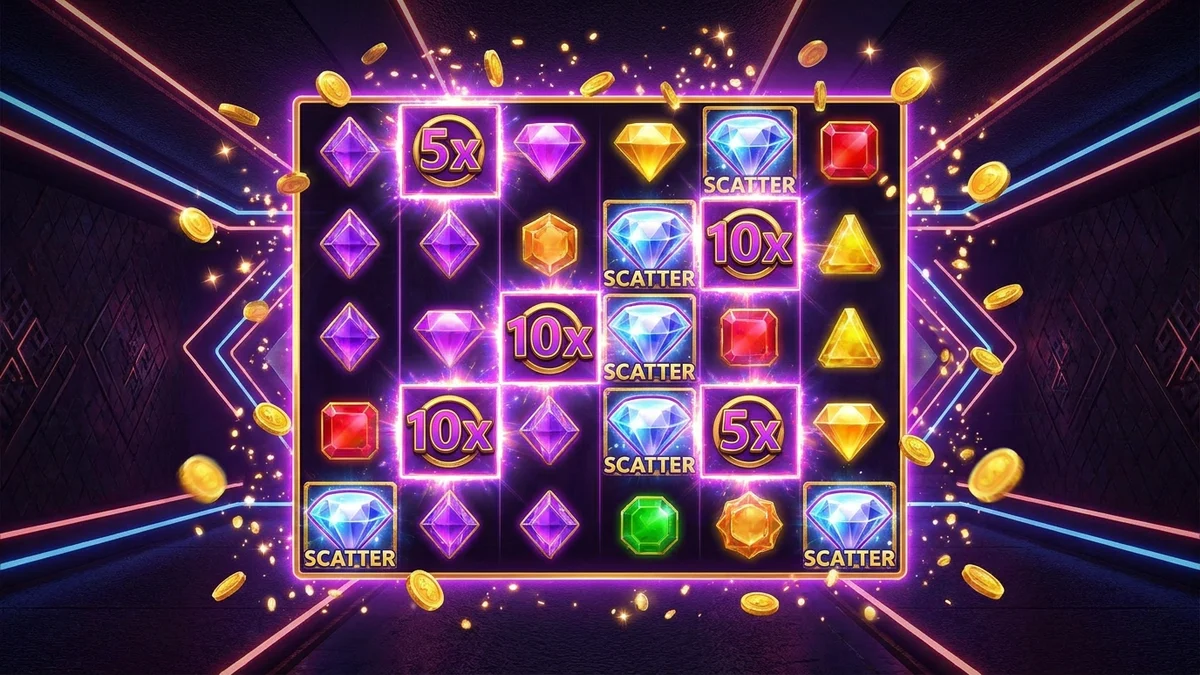
Classic reels are the three-reel machines: a handful of symbols, one or a few lines, fast and unadorned. Video slots are the five-reel mainstream — themes, layered features, animated bonus rounds. Grid games abandon reels for a block of symbols that pays on clusters or on scatter pays, tumbling away winners and dropping in replacements. And Megaways-style games shuffle the reel heights on every spin so the number of ways to win keeps moving.
You do not need to like all four. Most players discover fairly quickly that one engine speaks to them and the others feel like homework. Sampling them free is the fastest way to find out which — half an hour with Wolf Gold and half an hour with Sugar Rush will tell you more about your own taste than any amount of reading.
A useful shortcut for a beginner: if a game explains itself in one sentence, it will probably be readable. If the info screen needs four pages, three diagrams and a proprietary noun, it will probably take you a hundred spins to understand what you are looking at. Neither is worse, but the second kind deserves demo play before anything else, because paying to be confused is a poor use of money.
The feature glossary, in plain words
Free spins: a run of spins that costs nothing, usually improved in some way — bigger multipliers, extra wilds, a modified reel set. Wild: a symbol that stands in for others. Scatter: the trigger symbol, which usually does not care where it lands. Multiplier: a number that magnifies a win, and the source of nearly every genuinely large result in modern slots.
Tumble or cascade: winning symbols vanish, new ones fall in, and the process repeats until nothing new pays. Sticky: a symbol that stays put for subsequent spins. Retrigger: landing the trigger again during a feature to extend it. That is roughly ninety percent of the vocabulary — the rest is a studio inventing a proprietary name for something you already understand.
Your first session, step by step
Pick a game with a friendly reputation, open it in demo, and do nothing for the first minute except read the paytable. Set the bet low enough that the balance gives you a few hundred spins. Then spin — not on autoplay at first, but manually, so you actually watch what the game is doing rather than watching the number in the corner tick.
Give the game a hundred spins before you form an opinion. Notice how often anything pays, whether the small wins cover their own cost, how close you get to the scatters, and how you feel during the quiet stretches. If you reach the bonus, watch it carefully — that is where the game’s real personality lives, and it is the reason all the base-game patience exists.
Resist the urge to switch on autoplay immediately. Autoplay is a fine tool once you know a game, but for a beginner it turns a session into wallpaper — the reels blur, the wins register as noise, and you learn nothing except how quickly a number can move. Spin manually until you can predict, before the reels stop, roughly what a given screen is worth. That is the moment you have actually learned the game.
Mistakes beginners make almost universally
The first is chasing the feature by raising the stake after a dry spell, on the theory that the game owes them something. It does not. The second is judging a slot by a single session, which is like judging a book by a page picked at random. The third is confusing a big win screen with a big win — many games celebrate a payout smaller than the spin that produced it, with full fanfare.
The fourth, and the most expensive in the long run, is treating demo results as a forecast. A good run in free mode is not evidence of anything. If you have just tripled a virtual balance and feel a pull toward doing the same thing with real money, that feeling is the exact thing free play should have taught you to distrust.
There is one more mistake, quieter than the others: playing a game you do not enjoy because someone told you it was good. Popularity in slots is driven by clip culture and search volume, not by whether a game is pleasant to sit with. The best slot for you is the one you would still open if nobody else had ever heard of it, and free play is how you find it without paying for other people’s taste.
Where free demos fit into learning
A demo is a laboratory with an infinite budget. You can trigger a bonus twenty times to see its full range instead of once and never again. You can compare two games side by side in the same hour. You can deliberately play badly, blow the balance in thirty spins, and reload to see what that felt like — a lesson that would cost real money to learn anywhere else.
None of this makes you a better gambler in the sense of winning more, because that lever does not exist. What it makes you is a more literate player: someone who knows what they are looking at, chooses games deliberately, and is not surprised by their own machine. Literacy is the whole prize on offer here, and it happens to be free.
Use the demo to build a personal shortlist rather than a leaderboard. Three or four games you genuinely understand, whose features you can describe from memory, whose base games you can tolerate — that is a far more useful thing to own than a vague sense that some titles are famous. Depth beats breadth here, and it always has.
Keeping it in proportion
Casino slots are entertainment engineered to a very high standard, and there is nothing wrong with enjoying them on those terms. The trouble starts when the entertainment starts carrying expectations it was never built to meet. A slot is not an investment, a side hustle or a plan, and no volume of practice will convert it into one.
Everything at MySlots runs on virtual credits — no deposits, no withdrawals, no prizes, no catch. If you ever take these games to a real-money site, go in with a number you have already decided you can lose, and stop when you reach it whether you are up or down. These pages are for players aged 18 or over.
A quick word on bonus buys
Sooner or later you will meet a button offering to sell you the feature outright for a large multiple of your stake. It looks like a cheat code and it is nothing of the sort. The price is calculated so that buying the round returns roughly what patiently grinding toward it would have returned, and the effect is simply to remove the base game from the equation and hand you the volatile part on its own.
For a beginner that is a bad trade, because the base game is where you learn the machine. Buy a dozen features in demo by all means — it is an efficient way to see what a bonus can do — but understand what you are watching: a compressed, high-variance sample with the waiting removed. In a paid session, that same compression is how a bankroll disappears in ten minutes rather than two hours.
Frequently asked questions
Are casino slots hard to learn?
No. Slots require no skill or decisions — you set a bet and spin. The variety is in themes and features, which the demo lets you explore free.
What is the best casino slot for beginners?
Low-volatility classic or video slots are gentlest for beginners. Try several in free demo mode to find one you enjoy.
Can I play casino slots without registering?
Yes. At MySlots you can spin casino slots instantly as a guest, with no registration required.
What should I read before my first spin?
The paytable. It shows which symbols pay, how the scatter triggers the feature and what the maximum win is. Two minutes there makes the whole screen legible.
Why does my balance fall even when I keep winning?
Many wins are worth less than the spin that produced them. Games celebrate these small returns with full animation, which is why a session can feel positive while the number quietly drops.
How many spins before I can judge a slot?
Give it around a hundred. Anything less and you are judging noise, particularly on a high-volatility game where the personality only shows up in the bonus round.
Read next
Demo only - all games use virtual currency. No real money, no withdrawals, no prizes. Gambling with real money can be addictive; if you need support visit ncpgambling.org or call 1-800-GAMBLER. 18+ only.